
Limerence: Why You Cannot Stop Thinking About Them
Have you ever met someone who seemed to move into your mind without permission?
You wake up thinking about them. You replay a conversation while making coffee. You study the punctuation in their messages as though a missing period might reveal the future of your relationship. You promise yourself that you will stop checking your phone, then reach for it again five minutes later.
Part of you can see that the fixation is exhausting. Another part still believes the next message, meeting, or confession will finally settle everything.
This experience is often described as limerence.
Limerence can feel romantic because it contains longing, hope, attraction, and imagination. Yet it can also leave you anxious, distracted, and emotionally dependent on another person’s attention.
As a psychotherapist who works with attachment wounds and confusing relationship dynamics, I do not see limerence as proof that someone is weak, irrational, or incapable of healthy love. I see it as a pattern that deserves curiosity, honesty, and careful support.
But accuracy matters here.
Limerence is a psychological concept, not a formal mental health diagnosis. Researchers are beginning to develop better ways to measure it, but the evidence remains young. It should not be used as a label that explains every intense attraction or turns ordinary heartbreak into a disorder. See the American Psychological Association's definition of limerence.
If you are exploring deeper relationship patterns, you may also find value in learning about attachment wounds and healing through the Liminality Coach resources.
What Is Limerence?
Limerence describes an intense and often involuntary preoccupation with another person, usually paired with a powerful desire for romantic reciprocation.
The person at the center of the fixation may occupy a striking amount of your mental space. Your mood may rise when they show interest and fall when they become distant. You may search for hidden meaning in small interactions or imagine a future that has not been discussed, promised, or built.
Common experiences can include:
Repeated thoughts about the person
Strong longing for signs of reciprocation
Idealizing their personality or potential
Replaying conversations and messages
Imagining future intimacy
Feeling unusually sensitive to rejection
Checking messages or social media repeatedly
Allowing their attention to shape your mood
Struggling to focus on work, sleep, friendships, or daily life
Not everyone experiences every sign. Intense attraction can also be part of ordinary romantic love, especially early in a relationship.
The question is not simply, “Do I think about this person a lot?”
A better question is, “What is this attachment doing to my emotional freedom, judgment, and daily life?”
What Limerence Feels Like From the Inside
From the outside, limerence can look like a crush that has lasted too long.
From the inside, it can feel like living beside an unanswered question.
You may feel calm after receiving a warm message, then unsettled when the tone changes. You may experience a rush of hope after one affectionate interaction and spend the next day wondering whether you imagined its meaning.
The smallest details begin carrying emotional weight:
“They viewed my story.”
“They remembered something I said.”
“They took three hours to answer.”
“They called me beautiful, but what did they mean?”
Your mind becomes a courtroom where every glance, pause, and message is called forward as evidence.
This is one reason limerence can become so tiring. You are not simply feeling attraction. You are trying to solve uncertainty.
Why Uncertainty Can Intensify Limerence
Early writing about limerence identified uncertainty about reciprocation as one of its central features. Later clinical work has continued to treat uncertainty as an important part of the pattern, although far more research is still needed. Review the published clinical case study on limerence.
When another person’s interest is clear, the relationship can move toward mutual connection or an honest ending.
When their interest remains unclear, the mind may keep searching.
Perhaps they are warm one day and distant the next. Perhaps they flirt without stating what they want. Perhaps the relationship exists mainly through messages, brief meetings, or imagined possibilities.
Ambiguity leaves room for hope.
It also leaves room for projection.
Each small sign of attention can feel unusually valuable because it briefly relieves the discomfort of not knowing. When the attention disappears, the discomfort returns, and the mind begins searching again.
This does not prove that your brain is “addicted” to the person. That language is often used too carelessly. It does suggest that anticipation, reward, and uncertainty can become woven into the emotional loop.
Why Your Mind Keeps Returning to Them
Romantic infatuation can affect attention and cognitive control. Studies have found that infatuation and emotional attachment are related but distinguishable experiences, and intense infatuation may compete with your ability to direct attention elsewhere.
That helps explain why telling yourself to “stop thinking about them” rarely works.
A thought is not a light switch.
The more emotional meaning you attach to the person, the more easily reminders pull your attention back. A song, location, notification, or quiet evening can reopen the entire inner story.
Rumination then keeps the story active.
Rumination is repetitive thinking that circles the same emotional question without producing a useful answer. It may sound like reflection, but it often creates no new information.
“Why did they say that?”
“Did I ruin everything?”
“What if they are afraid of intimacy?”
“What if they come back?”
“What if this was my only chance?”
The mind promises that one more round of analysis will create certainty. Instead, it usually returns you to the beginning.
If you struggle with repetitive relationship thoughts, you may also benefit from exploring topics such as relationship anxiety, attachment styles, andemotional regulation on the Liminality Coach blog.
Why Limerence Can Feel Addictive
Some researchers have compared intense romantic love with addiction because both can involve craving, reward seeking, focused attention, and difficulty disengaging. Brain imaging studies have also found that romantic love engages regions involved in motivation and reward. Read the research on romantic love and reward systems.
Those similarities are real.
But they do not mean romantic love is identical to a substance addiction. They also do not make love addiction an established diagnosis.
The scientific literature uses terms such as love addiction, emotional dependence, manic love, and problematic love behaviors in inconsistent ways. Recent reviews warn that much of the research is correlational and uses different definitions and measurement tools.
So let us use the metaphor carefully.
Limerence can feel addiction like when:
You crave contact even when it repeatedly hurts you
You keep checking for reassurance despite wanting to stop
Brief attention produces relief
Distance produces distress
Other parts of your life begin losing importance
You keep pursuing the possibility rather than responding to reality
The problem is not that you have feelings.
The problem begins when the pursuit of relief starts replacing mutual relationship.
Obsession vs Love: What Is the Difference?
The difference between obsession vs love is not that love feels calm every second. Healthy love can include desire, excitement, fear, vulnerability, and conflict.
The difference is what the relationship gradually becomes.
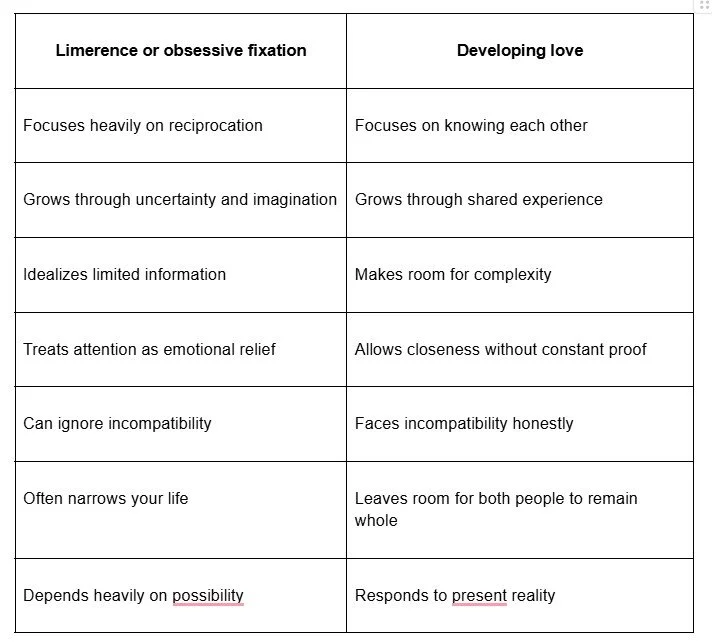
Love becomes more accurate as intimacy grows.
Limerence can become less accurate as fantasy grows.
Healthy love asks, “Who is this person, and who am I when I am with them?”
Limerence often asks, “How can I make this possibility become real?”
For a deeper exploration of healthy relationship dynamics, consider reading about secure attachment and healthy boundaries on Liminality Coach.
Fantasy Love: When Possibility Becomes More Powerful Than Reality
Fantasy is not always harmful.
We all imagine conversations, futures, reunions, and versions of ourselves we have not yet become. Imagination can help us recognize desire.
But fantasy love becomes painful when your imagined relationship begins carrying more emotional authority than the relationship you are actually living.
You may imagine how thoughtful they would be in a committed relationship without knowing how they handle responsibility. You may picture emotional intimacy without knowing whether they can tolerate honest conversation. You may treat chemistry as proof of compatibility.
The mind fills empty spaces quickly.
That is why it helps to separate three different people:
The person they have consistently shown themselves to be
The person they say they want to become
The person your longing needs them to be
Limerence often blends all three into one beautiful character.
Reality asks you to separate them again.
For related insights, explore resources on idealization in relationships and emotional awareness at Liminality Coach.
Is Limerence the Same as a Fantasy Bond?
Not exactly.
The term fantasy bond comes from psychologist Robert Firestone’s separation theory. In that framework, a fantasy bond is an imagined sense of fusion or connection that protects a person from loneliness, vulnerability, or fear. Learn more about the concept of a fantasy bond.
The two concepts may overlap when someone feels deeply attached to an imagined version of a relationship.
Still, they should not be treated as interchangeable facts.
A person experiencing limerence may idealize someone who is unavailable. A fantasy bond can also occur within an established relationship when partners rely on the idea of closeness while genuine curiosity, affection, and emotional contact fade.
In both cases, the central question is useful:
“Am I relating to the person in front of me, or to the emotional role I need them to play?”
Does Limerence Come From Attachment Wounds?
Sometimes attachment insecurity may be part of the picture.
Research connects anxious attachment with fear of rejection, heightened attention to relationship threats, reassurance seeking, and difficulty regulating emotions when closeness feels uncertain. Studies of problematic dependence and love addiction also report associations with insecure attachment. Review the research on attachment and problematic love behaviors.
But attachment wounds are not the only possible explanation.
Limerence may be shaped by several factors, including:
Loneliness
A recent breakup
Low self-worth
A strong need for validation
Limited relationship experience
Emotional unavailability in the other person
Stress or major life change
A tendency toward rumination
An unmet desire for meaning, intimacy, or escape
Be cautious with stories that reduce every intense attachment to childhood trauma.
Your history matters. Your present environment matters too.
Sometimes the person becomes symbolic. Their affection appears to promise more than relationship. It appears to promise proof that you are lovable, desirable, safe, or finally chosen.
That is a crushing amount of meaning to place inside someone else’s reply.
If attachment patterns resonate with you, explore additional guidance on healing attachment wounds and developing emotional security.
Why You Cannot “Just Move On”
You may already know the relationship is unavailable or unhealthy.
Knowing is not always the same as releasing.
You may be grieving several things at once:
The actual person
The attention they gave you
The future you imagined
The version of yourself you felt around them
The hope that being chosen would heal an older pain
This is why shame rarely helps.
Calling yourself foolish does not remove attachment. It only adds self-rejection to heartbreak.
You do not need to humiliate yourself to heal.
You need to see the pattern clearly enough that fantasy no longer gets to write reality’s lines.
How to Stop Obsessive Love Patterns
There is no single proven treatment created specifically for limerence. Published clinical evidence remains limited, and one commonly cited cognitive behavioral treatment report involved only one case.
That means anyone promising an instant clinical cure is selling certainty that the research has not earned.
Still, several strategies are consistent with what we know about rumination, emotional regulation, boundaries, and recovery from romantic distress.
1. Name the Pattern Without Making It Your Identity
Try saying:
“I am experiencing limerent thoughts.”
That is different from saying:
“I am obsessive.”
The first statement describes an experience. The second turns the experience into your identity.
Naming the pattern helps you notice it without automatically obeying it.
You can have a thought without treating it as a command, prophecy, or piece of evidence.
2. Separate Facts From Interpretation
Create two columns.
In the first, write what the person has clearly said or consistently done.
In the second, write what you have inferred, hoped, predicted, or explained for them.
For example:
Fact: They have not asked for a committed relationship.
Interpretation: They are afraid because their feelings are too strong.
Fact: They contact me when they feel lonely.
Interpretation: Our connection is rare and they will eventually realize it.
This exercise can sting.
It can also return you to your own intelligence.
3. Reduce the Behaviors That Feed the Loop
Limerence is not maintained by thoughts alone. It is often maintained by rituals.
These may include:
Checking their social media
Rereading messages
Looking at old photographs
Asking friends to interpret their behavior
Posting content to attract their attention
Monitoring who they follow
Creating reasons to contact them
Returning repeatedly to places where you may see them
Research on breakup recovery has linked monitoring an ex-partner on social media with greater distress, longing, and negative feelings. Read the study on social media surveillance after breakups.
Mute, unfollow, archive, or block when needed.
A boundary is not a punishment. It is a way of removing your nervous system from an argument it cannot win.
4. Stop Treating Every Thought as a Problem to Solve
Trying to force a thought away can turn the thought into an emergency.
Instead, notice it.
“There is the reunion fantasy.”
“There is the urge to check.”
“There is the story that I need one final answer.”
Then return your attention to the next chosen action.
Mindfulness-based approaches and rumination focused cognitive therapies have shown benefits for repetitive negative thinking in broader clinical populations. Explore the evidence on mindfulness and rumination reduction.
The goal is not to produce a perfectly silent mind.
The goal is to stop giving every thought a meeting.
5. Widen Your Emotional World
Limerence makes one person feel like the sun.
Everything else becomes a distant planet.
Begin moving some of your emotional energy back into ordinary life:
See friends who help you feel present
Return to creative work
Move your body regularly
Protect your sleep
Make plans that do not involve the person
Learn something that requires attention
Spend time in places with no emotional history attached
Reconnect with your values and future goals
Do not wait until you feel inspired.
Action can come before emotional readiness.
Your life does not need to feel fascinating every day. It only needs to become larger than the loop.
6. Grieve the Fantasy as Well as the Person
You may be mourning a relationship that never became what you hoped.
That grief is still real.
Write down the future you imagined. Name what it represented. Perhaps you wanted tenderness, intellectual companionship, sexual safety, adventure, reassurance, or belonging.
Then ask:
“Which part of this longing belongs to this person, and which part belongs to the life I still want to build?”
The imagined future may not be available with them.
Its deeper values may still be available to you.
7. Listen to Your Gut, Then Check the Evidence
Your gut may tell you that something feels intense.
Intensity is information, but it is not always instruction.
Ask:
Do this person’s actions match their words?
Can I voice my needs without fear or self abandonment?
Does contact leave me clearer or more confused?
Am I accepting who they are?
Am I waiting for potential to become character?
Is this connection mutual?
Does this relationship respect my dignity?
Love asks us to remain emotionally open.
Wisdom asks us to remain awake.
8. Seek Professional Support When the Pattern Is Taking Over
Consider speaking with a licensed mental health professional when the fixation:
Disrupts sleep, work, eating, or concentration
Leads to repeated unwanted contact
Keeps you in an unsafe or exploitative relationship
Causes severe anxiety or depression
Becomes connected to self harm or hopelessness
Feels impossible to manage alone
Because limerence is not a formal diagnosis, a responsible clinician should look beyond the label. They may explore attachment, grief, anxiety, depression, trauma, compulsive behavior, loneliness, or another condition that better explains your experience.
The goal is not to pathologize your capacity for desire.
The goal is to understand why desire has become a cage.
If you would like personalized support, explore relationship coaching and therapy-informed guidance through Liminality Art.
You Are Not Broken for Feeling This Deeply
Limerence can reveal a powerful hunger for connection.
That hunger is not shameful.
What deserves attention is where the hunger leads you.
Does it lead toward mutuality, honesty, and embodied intimacy?
Or does it lead toward guessing, waiting, shrinking, and abandoning yourself?
Healing does not require you to become cold.
It asks you to become more discerning.
You can keep your sensitivity without surrendering your judgment. You can honor your longing without turning another person into its only possible answer. You can love poetry without mistaking every unfinished sentence for destiny.
Real love is not made smaller by reality.
It becomes more trustworthy inside it.
