
What Happens in Trauma Bond Therapy?
A trauma bond can make a harmful relationship feel almost impossible to leave. You may miss the person who frightened you, replay the loving moments, or judge yourself for returning.
Trauma bond therapy is not one formal treatment with a single method or fixed number of sessions. It is a common search term for therapy that helps a person understand a powerful attachment formed inside a harmful romantic relationship. Treatment may include safety planning, trauma-informed care, attachment work, emotional regulation, grief work, and treatment for post-traumatic stress when needed.
Early research on traumatic bonding in abusive relationships linked continued attachment with intermittent mistreatment and unequal power. More recent research found that childhood maltreatment, attachment insecurity, traumatic bonding, and posttraumatic stress symptoms can be connected in people who are currently experiencing abuse. These findings describe patterns and risk factors. They do not make the harmed person responsible for another person's behavior.
I do not see the part of you that still feels attached as foolish. I see a part that learned to search for relief inside the same relationship that created fear. Therapy helps you understand that pattern without turning your pain into another reason to shame yourself.
What Is Trauma Bond Therapy?
Trauma bond therapy is individual mental health treatment for someone who feels strongly attached to a romantic partner within a relationship marked by abuse, coercive control, repeated degradation, intimidation, or another serious imbalance of power.
The phrase can be misleading because there is no single therapy called trauma bond therapy. A scoping review of trauma bonding research found that the field still lacks a clearly established treatment model for breaking a trauma bond and replacing it with healthy attachment. That review focused on trafficking survivors, so its findings should not be stretched across every romantic relationship. It still points to a major gap: online certainty has moved faster than clinical research.
A careful therapist treats the problems that are actually present, such as current danger, posttraumatic stress symptoms, shame, grief, repeated urges to reconnect, loss of identity, or earlier attachment wounds.
The goal is not to make you hate your partner or former partner. The goal is to help you see the relationship clearly, become safer, and make choices that do not require abandoning yourself.
Why Is a Trauma Bond So Hard to Break?
Harm and relief become linked.
A trauma bond may grow when harm is followed by tenderness, apology, promises, or calm. Relief can feel intense because it arrives after distress. In the original study testing traumatic bonding theory, intermittent mistreatment and differences in power were associated with attachment to a former abusive partner, trauma symptoms, and self-esteem after separation, as described in this foundational study on traumatic bonding.
This does not mean a single argument followed by repair creates a trauma bond. Healthy couples can hurt each other, take responsibility, change behavior, and repair without fear. Trauma bonding is tied to harm and power, not ordinary relationship friction.
Attachment can outlast the relationship.
Leaving does not instantly change your memories, hopes, grief, or learned responses. You may still watch for danger, affection, or reassurance.
A 2023 study of 354 people in current abusive relationships found that attachment insecurity and childhood maltreatment were linked with traumatic bonding, and traumatic bonding was associated with posttraumatic stress symptoms, as shown in this research on trauma bonding and PTSD symptoms. This does not mean childhood pain causes someone to choose abuse. It means earlier wounds may affect how danger, closeness, and separation are experienced.
You may be grieving more than the person
You may be grieving the future you were promised. You may be grieving the apology that felt almost real, the home you planned, or the version of the relationship that appeared during its gentler seasons.
That grief can make leaving feel like betraying your own hope. Therapy helps separate hope from evidence. It asks a hard but useful question: What has this person repeatedly done, not only what have they repeatedly promised?
Trauma Bonding Compared With Similar Patterns
These terms overlap, but they are not interchangeable.
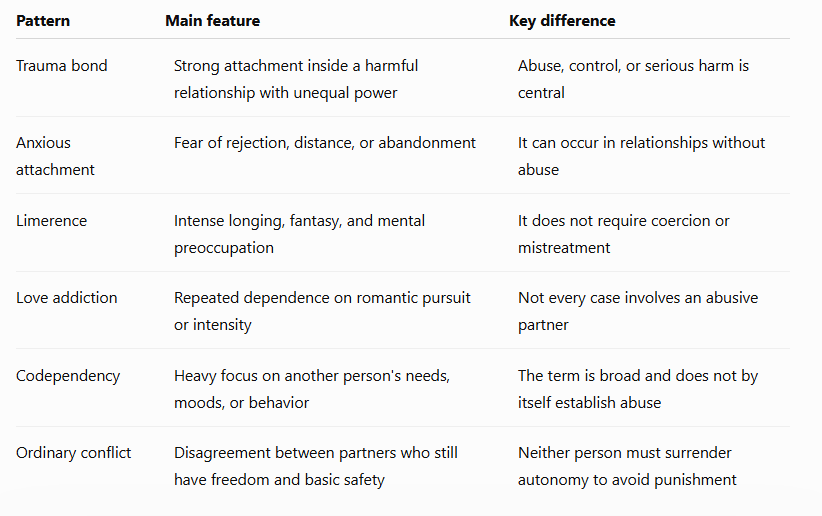
A therapist should not diagnose your relationship from a viral checklist. Context matters. A useful assessment looks at fear, freedom, retaliation, control, patterns of harm, and what happens when you say no.
What Happens in the First Sessions?
Your therapist listens before deciding what your story means.
The first task is not to convince you to leave, stay, forgive, confront, or cut contact. It is to understand what has happened, what is happening now, and what you need.
A trauma-informed approach should build physical and emotional safety, trust, shared decision-making, and respect for the client's voice. The Substance Abuse and Mental Health Services Administration guidance on trauma-informed care also warns against practices that repeat coercion in care.
Your therapist may ask about threats, stalking, physical or sexual harm, money, housing, private communication, children, sleep, panic, substance use, self-harm, trusted support, and what happens when you create distance.
Safety is assessed without taking away your agency.
Safety planning may address digital privacy, trusted contacts, documents, transportation, money, housing, or leaving a dangerous moment. It must fit your life because a careless plan can increase risk.
The World Health Organization guidance on first-line support for survivors calls for practical care that responds to a survivor's concerns without intruding on autonomy. It also recommends listening without pressure, offering comfort, sharing information, and helping the person connect with services and social support.
When immediate danger is present, contact local emergency services or a domestic violence service in your country from a device the other person cannot access. Therapy is important, but it is not an emergency response system.
The relationship cycle is mapped.
You and your therapist may create a timeline of the relationship. This can include early intensity, the first boundary violation, periods of fear, apologies, promises, reunions, and what happened after each reunion.
The purpose is to help your mind hold the whole pattern at once rather than only the latest crisis or loving moment.
The Main Stages of Trauma Bond Therapy
Therapy rarely moves in a perfect order. Safety, grief, memory work, boundaries, and attachment work may overlap.
1. Building safety and emotional steadiness
Before deeper trauma work, many clients need ways to manage panic, numbness, sleep loss, intrusive thoughts, or urges to reconnect. Grounding and plans for high-risk moments can create more room between a feeling and an action.
2. Naming the pattern without blaming yourself
Therapy may help you identify minimization, self-blame, memory doubt, and the habit of judging the relationship by its best moments. Insight may grow before attachment fades, so therapy makes room for clarity and longing at the same time.
3. Tolerating separation distress
Distance may bring grief, fear, guilt, physical agitation, loneliness, or a powerful urge to reconnect. These feelings can be mistaken for proof that leaving was wrong.
A therapist may help you prepare for messages, anniversaries, apologies, or sudden promises of change. No contact may help some people, but shared parenting, housing, finances, work, or safety concerns may require structured contact.
4. Processing trauma when you are ready
Some people develop posttraumatic stress symptoms after intimate partner violence or coercive control. When those symptoms are present, a qualified therapist may discuss a trauma-focused treatment.
The National Center for PTSD overview of evidence-based therapies identifies Cognitive Processing Therapy, Prolonged Exposure, and Eye Movement Desensitization and Reprocessing as strongly supported treatments for PTSD. These therapies treat trauma symptoms. They are not proven cures for trauma bonding as a separate condition.
Trauma processing should not be rushed. Readiness involves safety, consent, coping capacity, and a plan that fits the person.
5. Grieving the person and the imagined future
Grief may include love, lost time, betrayal, identity, and the future you thought you were building.
You may not need to prove that every moment was false. Good moments can have been real to you, and the relationship can still have been unsafe. Healing does not require rewriting every memory. It requires placing each memory inside the whole story.
6. Rebuilding identity and boundaries
Trauma bonds often shrink life. Therapy may help you reconnect with people, work, creativity, rest, pleasure, and personal preferences.
You may also practice boundaries that do not depend on the other person agreeing with them. A boundary is not a speech designed to make someone understand. It is a decision about what you will do when a line is crossed.
7. Learning what secure love feels like
Healthy love may feel quiet after fear and relief. Consistency can feel unfamiliar, and respect may feel less intoxicating than pursuit.
Therapy can help you notice the difference between chemistry and activation, closeness and engulfment, care and rescue, longing and compatibility. The aim is not to remove desire. It is to give desire a floor strong enough to stand on.
Which Therapy Approaches May Be Used?
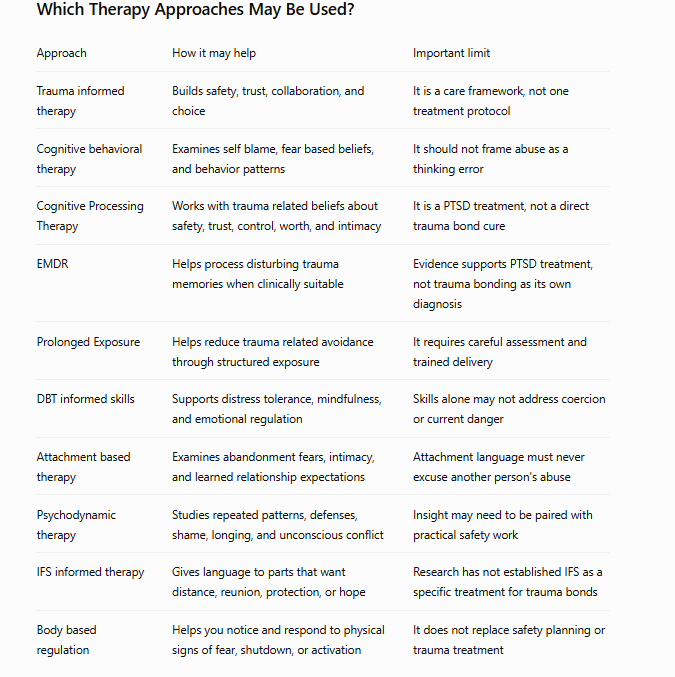
A 2023 systematic review and meta-analysis of psychosocial interventions for intimate partner violence survivors found that treatment can support mental health and psychosocial outcomes, while also noting major variation across survivors, settings, and studies. The honest conclusion is not that one method fixes every bond. It is that treatment should match the person's symptoms, safety, history, and goals.
A Composite Example of Trauma Bond Therapy
This fictional example combines common themes and does not describe one client.
Maya ended a four-year relationship after intimidation, monitoring, and repeated apologies. Each tender message felt different, while silence brought panic and guilt.
In therapy, Maya first worked on digital safety and identified two people she could contact when she felt pulled to respond. She mapped the relationship cycle and noticed that apologies usually appeared after she created distance. She learned to pause before replying and to read her relationship timeline when memory narrowed to the last loving message.
Later, Maya worked through trauma memories, grieved the imagined future, rebuilt friendships, and made small decisions without seeking approval.
Progress was not a clean break. She replied several times. Instead of treating those moments as failure, therapy examined what happened before each reply. Loneliness, family stress, and anniversaries were common triggers. With time, Maya still had feelings, but those feelings stopped making every decision for her.
What Does Progress Look Like?
Progress is not measured only by whether you stop loving or missing the person.
It may look like this:
Pausing before answering a message
Seeing the full pattern rather than one tender moment
Trusting your memory with less outside proof
Feeling grief without returning automatically
Setting boundaries with fewer explanations
Choosing from your values rather than panic
There is no honest universal timeline. The length of therapy depends on current safety, trauma symptoms, practical barriers, support, earlier wounds, and the kind of relationship contact that remains.
Is Couples Therapy Safe for a Trauma Bond?
Couples therapy is not automatically safe when a relationship includes fear, coercive control, threats, stalking, retaliation, or violence. Joint disclosure can create danger after the session. A partner may also use therapy language to blame, monitor, or silence the other person.
A systematic review on couples therapy in the context of intimate partner violence found preliminary support only in select situations and noted professional concern about violent retaliation. The review discussed situational violence, which is not the same as a relationship ruled by coercive control.
Joint therapy may be considered only after careful private screening by a clinician trained in intimate partner violence. Both partners must have real freedom to speak, disagree, and leave the session without punishment. Better communication cannot repair a structure built on fear.

Therapy, Coaching, or Self-Guided Support?
Different forms of support serve different needs.
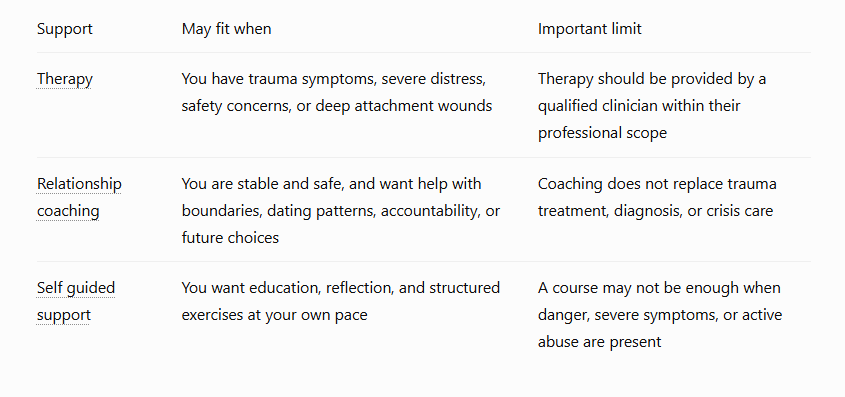
You do not need to choose the most intense form of support to prove that your pain is real. You need the form that fits your safety, symptoms, goals, and capacity right now.
To discuss which path may fit, you can contact Olympia.
Your Attachment Is Not Proof That You Belonged in Pain
I will not ask you to shame the part of you that still loves, hopes, or remembers the good moments. That part may have survived uncertainty by holding tightly to each sign of relief.
Our work is not to punish that part. It is to listen to it, protect it, and give it choices that do not require self-abandonment.
You may choose therapy for clinical trauma work, coaching for future-focused relationship change, or self-guided support for structured learning. The right next step is not the one that looks strongest from the outside. It is the one that brings you closer to safety, clarity, and your own voice.
Frequently Asked Questions
What does a therapist do for a trauma bond?
A therapist may assess safety, map the relationship pattern, treat trauma symptoms, help you manage urges to reconnect, and support grief, boundaries, and identity repair. Trauma-informed care should respect your choices rather than recreate control inside the therapy room, as outlined in SAMHSA’s trauma-informed care guidance.
Can therapy make a trauma bond disappear?
Therapy cannot erase attachment on command. It can help reduce confusion, self-blame, trauma symptoms, and automatic responses while increasing your ability to make safer choices. Research has not established one treatment that directly and reliably removes trauma bonding in every person, as noted in this scoping review of trauma bonding research.
Can EMDR help with a trauma bond?
EMDR may help when trauma memories and posttraumatic stress symptoms are present. It is supported as a treatment for PTSD, but it has not been established as a specific cure for trauma bonding, according to the National Center for PTSD’s EMDR overview.
Do I have to stop all contact before therapy can work?
No. Therapy can begin while you are still in the relationship, considering leaving, separated, or maintaining necessary contact. Contact decisions should reflect safety, shared responsibilities, legal concerns, finances, housing, and your own circumstances.
What if I return to the relationship after starting therapy?
Returning does not make you weak or beyond help. Therapy can examine what pulled you back, restore the safety plan, and change the support around your highest risk moments. Shame usually hides the pattern. Honest reflection gives you more room to change it.