When Relationship Anxiety May Need Therapy
A delayed text can feel like rejection. A quiet evening can feel like proof that something has changed. A small disagreement can send you searching through every conversation, facial expression, and message for the exact moment love began to disappear.
Sometimes, relationship anxiety reflects an old fear. Sometimes, it responds to something happening in the relationship now. Often, it is a conversation between both.
Therapy for relationship anxiety may be worth considering when worry becomes difficult to control, keeps returning after reassurance, or begins affecting your sleep, concentration, work, friendships, self-trust, or ability to communicate honestly.
The World Health Organization explains that anxiety becomes a mental health concern when fear and worry are intense, persistent, difficult to manage, and disruptive to daily life.
You do not need to wait until your relationship is falling apart before seeking support. Therapy can help you understand whether your emotional alarm is pointing toward an old wound, a present problem, or both.
What Is Relationship Anxiety?
"Relationship anxiety" is a plain language phrase for recurring fear, doubt, or insecurity connected to a romantic relationship. It can involve fear of abandonment, worry that your partner has lost interest, uncertainty about your own feelings, jealousy, repeated reassurance-seeking, or a constant need to know where the relationship is going.
Relationship anxiety is not a formal diagnosis named in the World Health Organization’s classification of anxiety disorders. A therapist may instead assess whether the anxiety relates to generalized anxiety, panic, obsessive compulsive symptoms, trauma, depression, attachment patterns, relationship distress, or another concern.
This matters because the same behavior can serve different emotional purposes.
One person may check a partner’s social media because they fear abandonment. Another may check because trust was recently broken. Someone else may feel driven by an intrusive doubt that never feels resolved, no matter how much evidence they collect.
The behavior may look similar. The emotional roots may be very different.
Relationship Anxiety Can Appear in Stable or Unstable Relationships
Feeling anxious does not automatically mean your relationship is unsafe. It also does not mean your concerns are irrational.
Relationship anxiety may come from:
• An internal anxiety or attachment pattern
• A partner’s inconsistent or dishonest behavior
• A past betrayal that still feels present
• Unspoken needs or unclear expectations
• Fear of intimacy, engulfment, or abandonment
• Obsessive doubt and repeated certainty seeking
• A combination of personal history and current relationship conditions
One of the most useful questions I ask is this:
Is my fear coming from an old wound, current evidence, or both?
Therapy gives you room to answer that question without shaming your nervous system or placing every problem inside your childhood.
Common Signs Relationship Anxiety Is Taking Over
Relationship anxiety can shape your emotions, your thoughts, and the way you behave with your partner.
Emotional signs: Thought patterns: Behaviors: Fear of abandonment Replaying conversations Repeatedly asking for reassurance Jealousy or dread Reading hidden meaning into messages Checking online activity Trouble feeling secure Imagining rejection Testing your partner’s love Shame after conflict Comparing your relationship Overgiving to prevent someone from leaving Panic during distance Doubting your feelings Avoiding direct conversations Emotional exhaustion Expecting sudden loss Withdrawing before you can be rejected
You may recognize one or two of these patterns during a stressful season. That does not mean you have an anxiety disorder.
The deeper concern is repetition. Does the fear continue after the issue has been discussed? Does it keep returning in different forms? Does reassurance calm you for an hour and then lose its power?
Reassurance Helps, but Only Briefly
Reassurance can be healthy. Partners should be able to offer warmth, clarity, and comfort.
The problem begins when reassurance becomes the only way you can feel safe, and even then, safety lasts only a short time.
The cycle often looks like this:
A trigger creates fear.
You ask whether the relationship is okay.
Your partner reassures you.
You feel relief.
A new doubt appears.
You need another answer.
Research has found a connection between attachment anxiety and excessive reassurance seeking in romantic relationships. Partners may also notice the pattern, even when the reassurance seeker feels they are only trying to restore closeness.
The goal of therapy is not to make you need nothing. It is to help reassurance become part of connection rather than the price of emotional survival.
Checking, Testing, and Mental Review
Relationship anxiety may also appear as repeated checking.
You might:
• Reread messages to measure your partner’s tone
• Watch whether they are active online
• Compare how quickly they respond to other people
• Ask questions you already asked yesterday.
• Test whether they will notice you pulling away
• Mentally review whether you truly love them.
• Search for proof that the relationship is right or wrong
Some intrusive relationship doubts and repetitive checking behaviors can occur within obsessive compulsive disorder. The National Institute of Mental Health describes OCD as a condition involving recurring unwanted thoughts, repetitive behaviors, or both. Only a qualified clinician can determine whether a person meets diagnostic criteria.
A thought being repetitive does not automatically make it OCD. A clinician will look at how often it appears, how much distress it causes, whether it leads to rituals, and how much time and freedom the pattern consumes.
Normal Relationship Uncertainty or a Sign You May Need Therapy?
Not every doubt needs treatment.
Relationships ask us to live with some uncertainty. No partner can promise that feelings will never change, conflict will never happen, or loss will never arrive. Intimacy requires trust without complete control.
Normal uncertainty may appear during:
• The early stages of dating
• A recent disagreement
• A major commitment
• A temporary communication problem
• A period of stress or transition
• Recovery after a previous breakup
• A conversation about exclusivity, marriage, or family
This anxiety may soften when you receive clear information, have an honest conversation, or move through the stressful period.
Therapy may be worth considering when:
• Worry feels difficult to control
• The same fear appears in several relationships
• Anxiety affects sleep, eating, focus, work, or friendships.
• Reassurance gives only brief relief.
• You repeatedly check, test, pursue, or withdraw
• Conflict causes panic or emotional shutdown
• You cannot express needs without intense fear.
• You abandon your values to keep someone close.
• A past betrayal feels present in every new relationship.
• Self-help has not changed the pattern
The National Institute of Mental Health recommends professional support when distressing symptoms persist or interfere with daily functioning.
You do not have to prove that your suffering is severe enough. If the pattern is shrinking your life, that is worth discussing.
Your Anxiety Is Not Always the Problem
This is one of the most important distinctions in therapy for relationship anxiety.
Sometimes the nervous system is remembering an old danger. Sometimes it is accurately noticing a present one.
If your partner regularly disappears, lies, breaks agreements, gives mixed messages, humiliates you, controls your choices, or punishes you for expressing needs, your anxiety may not be a distorted response. It may be information.
Therapy should not teach you to breathe more calmly while someone repeatedly violates your boundaries.
When Anxiety Responds to Real Inconsistency
Ask yourself:
• Does my partner’s behavior match their words?
• Can we discuss concerns without punishment or ridicule?
• Do I receive clear answers or more confusion?
• Am I reacting to a possibility or a repeated pattern?
• Do I feel safer after honest conversations?
• Am I being asked to ignore evidence to preserve the relationship?
A therapist can help you examine the difference between emotional memory and current reality. That does not mean forcing a clean answer when both are present.
You may have an old abandonment wound and a partner who is unreliable. You may carry betrayal trauma and be dating someone trustworthy. You may fear engulfment and also need stronger boundaries.
Human relationships rarely arrive in neat categories.
When the Relationship Is Unsafe
Physical harm is not the only form of relationship danger. Intimate partner violence can include physical aggression, sexual coercion, psychological abuse, intimidation, surveillance, isolation, and controlling behavior.
The World Health Organization links intimate partner violence with depression, trauma symptoms, anxiety, sleep problems, and suicide attempts.
When coercion or abuse is active, couples therapy may create added risk. The National Domestic Violence Hotline advises against attending couples counseling with an abusive partner because shared sessions may create opportunities for blame, retaliation, or manipulation.
Individual support, confidential safety planning, and local abuse services may be safer starting points.
What Can Cause Relationship Anxiety?
There is rarely one cause.
Relationship anxiety can grow from the interaction between your history, your temperament, your coping habits, your partner’s behavior, and the emotional culture surrounding love.
Attachment Anxiety and Early Relationship Learning
Attachment anxiety often involves heightened fear of rejection or abandonment. A person may closely watch for signs of distance and work hard to restore closeness.
You may have learned that love was available but unpredictable. Perhaps attention arrived when you performed, pleased, achieved, or became useful. Perhaps conflict threatened the bond. Perhaps you had to study another person’s mood to know whether connection was safe.
These experiences can shape expectations, but attachment language should not become a life sentence.
You are not “an anxious person” carved in stone. You may have anxious strategies that appear when closeness feels uncertain.
Betrayal, Infidelity, or Past Relationship Trauma
After betrayal, the mind often searches for ways to prevent surprise.
You may become more alert to changes in tone, availability, affection, or sexual connection. What looks like overthinking may be your system trying to make sure it is never blindsided again.
The National Institute of Mental Health notes that trauma symptoms can affect thoughts, emotions, behavior, sleep, work, and relationships. Persistent symptoms deserve assessment, especially when they interfere with daily life.
Healing does not require you to forget what happened. It asks you to learn when the past is speaking, when the present is speaking, and how to listen to both without surrendering your life to either one.
General Anxiety, Panic, or Depression
Sometimes relationship worry is one room inside a much larger house of anxiety.
You may also worry about health, work, money, family, social judgment, or making the wrong decision. Anxiety disorders can involve persistent worry, tension, restlessness, poor concentration, sleep problems, physical symptoms, and avoidance, according to the World Health Organization.
Depression can also shape how you interpret closeness, conflict, worth, and rejection. A full assessment helps the therapist understand whether relationship fear is the main concern or one part of a broader mental health pattern.
Obsessive Doubt and Certainty Seeking
Some people become trapped in questions such as the following:
• Do I truly love my partner?
• Are they the right person?
• What if I am settling?
• What if they leave?
• What if I miss a warning sign?
• What if I never feel completely certain?
The problem is not always the question. The problem may be the demand for an answer that feels permanently certain.
Repeated checking, comparing, confessing, researching, or asking others for reassurance can strengthen the loop. For people diagnosed with OCD, exposure and response prevention is a form of cognitive behavioral therapy that can reduce compulsive behavior.
This approach should be guided by a clinician trained to assess and treat OCD.
A Relationship That Does Not Meet Your Needs
Sometimes anxiety continues because the relationship continues to provide reasons for anxiety.
You may be trying to regulate yourself around a connection that lacks trust, honesty, emotional availability, compatibility, or shared direction.
Not every relationship should be saved. Not every ending is evidence that anxiety won.
Sometimes healing means becoming calm enough to stay. Sometimes it means becoming clear enough to leave.
How Therapy for Relationship Anxiety Can Help
Psychotherapy is not simply a place to describe what happened that week. It can help you identify patterns in your thoughts, emotions, choices, and relationships.
The National Institute of Mental Health explains that psychotherapy can help people identify and change troubling emotions, thoughts, and behaviors. The approach should reflect the person’s needs, diagnosis, history, and treatment goals.
Separate Fear From Evidence
Therapy may help you slow the moment down and ask the following:
• What happened?
• What did I fear it meant?
• What evidence supports that meaning?
• What other explanations exist?
• What pattern has the relationship shown over time?
• What response reflects my values?
This is not about arguing with every feeling. It is about letting feelings bring information without handing them complete control.
Reduce Reassurance Seeking and Checking
A therapist can help you notice what happens just before you ask for reassurance or begin checking.
Perhaps an exile inside you fears being forgotten. A manager tries to prevent rejection by analyzing every detail. A firefighter tries to stop the pain through pursuit, withdrawal, anger, or emotional numbing.
These parts are not enemies. They are strategies.
Therapy can help you understand what each part is protecting while building responses that do not keep the anxiety alive.
Voice Your Needs More Clearly
Relationship anxiety often grows in silence.
You may hope your partner will notice what you need without being told. You may soften every request until it disappears. You may express fear as criticism because vulnerability feels too exposed.
Therapy can help you replace testing with direct language:
“I feel disconnected, and I would like time together.”
“I need clarity about where this relationship is going.”
“When communication changes without explanation, I feel unsettled.”
“I can respect your need for space, but I also need a clear plan for reconnecting.”
Speaking directly does not guarantee the answer you want. It gives you better information.
Rebuild Self Trust
Relationship anxiety can make every decision feel dangerous.
You may stop trusting your perceptions, your boundaries, your attraction, or your ability to survive disappointment.
Therapy can help you build a steadier relationship with yourself. The goal is not perfect certainty. It is knowing that you can gather information, voice your needs, revise your choices, and care for yourself when reality is painful.
Which Therapy Approaches May Help?
No single approach fits every person.
A therapist should consider your symptoms, history, relationship conditions, preferences, and safety.
Cognitive Behavioral Therapy
Cognitive behavioral therapy examines connections among thoughts, emotions, and behavior.
You may learn to notice catastrophic predictions, question assumptions, reduce avoidance, and change habits that feed anxiety. The American Psychological Association reports that cognitive behavioral therapy has support across anxiety disorders and relationship concerns.
Exposure and Response Prevention
Exposure and response prevention may be considered when a clinician identifies obsessive fears and compulsive reassurance, checking, confession, or mental review.
The work involves gradually facing uncertainty while reducing the ritual used to gain relief. The goal is not proving that the relationship is safe. It is learning that uncertainty can be tolerated without performing a compulsion.
Attachment-Based or Psychodynamic Therapy
These approaches may explore early relationships, repeated patterns, fear of abandonment, fear of engulfment, shame, defense, and the meanings attached to closeness.
The purpose is not to blame your parents for every dating problem. It is to understand how old adaptations may be entering present intimacy.
Internal Family Systems
Internal Family Systems offers language for inner conflict.
One part may want closeness. Another may fear dependence. One may chase it. Another may shut down. One may romanticize the partner. Another may search constantly for reasons to leave.
Current published work describes IFS as a family systems-informed model, though its research base for relationship anxiety is less established than the evidence supporting cognitive behavioral treatments for anxiety and OCD. (Sweezy and colleagues, 2023)
Trauma-Informed Therapy
Trauma-informed work may help when relationship anxiety is tied to betrayal, abuse, coercion, abandonment, or other threatening experiences.
Treatment may focus on emotional regulation, boundaries, memory, shame, safety, and the ability to remain present when the body expects danger.
Couples Therapy
Couples therapy may help when both partners want to understand and change a shared cycle.
A large meta-analysis of couple therapy found gains in relationship satisfaction across treatment studies, with distressed couples often showing meaningful improvement.
Couples work may fit when:
• Both people feel safe speaking honestly.
• Both are willing to examine their behavior.
• Conflict follows a repeated interaction pattern.
• Trust needs shared repair
• The relationship has enough safety for vulnerable work
Couples therapy is not the right starting point when one partner is abusive, coercive, or likely to retaliate.
Individual Therapy or Couples Therapy?
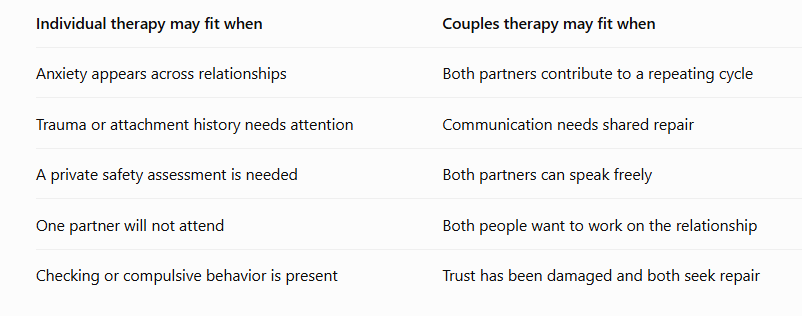
Some people use both forms of support at different stages.
Individual therapy may help you understand and regulate your responses. Couples therapy may help both partners change what happens between them.
Therapy Versus Relationship Coaching
Therapy and coaching can both support change, but they do not serve the same purpose.
Therapy may be the better starting point when:
• Anxiety interferes with daily functioning.
• Trauma, depression, panic, OCD, or self-harm concerns may be present
• Clinical assessment is needed.
• Emotional distress prevents steady action.
• Safety concerns exist
• Past experiences require mental health treatment.
Relationship coaching may fit when:
• You are functioning steadily.
• You want clearer relationship decisions
• You want structure and accountability.
• You are building communication or dating skills.
• Mental health symptoms are not blocking the work.
The International Coaching Federation advises coaches to refer clients when a concern falls outside their competence or interferes with everyday functioning.
One is not morally better than the other. The right choice depends on what kind of support the situation requires.
You can learn more about liminality therapy, compare it with relationship coaching, or explore The Aligned Love Course.
What to Expect in Therapy for Relationship Anxiety
During the first sessions, a therapist may ask about:
• Current relationship concerns
• Anxiety symptoms and triggers
• Previous relationships
• Family and attachment history
• Betrayal, loss, trauma, or abuse
• Sleep, work, health, and daily functioning
• Reassurance, checking, avoidance, or conflict habits
• Your goals for therapy
The therapist may also screen for anxiety disorders, depression, trauma symptoms, panic, OCD, substance use, and relationship safety.
Good therapy does not rush to decide whether you should stay or leave. It helps you become more able to see, choose, and act.
Progress may look like:
• Less compulsive checking
• More tolerance for uncertainty
• Clearer communication
• Stronger boundaries
• Better emotional regulation
• Less self-abandonment
• More attention to patterns than promises
• Greater trust in your capacity to handle the truth
Progress does not always mean staying together. Sometimes therapy strengthens a relationship. Sometimes it reveals that the relationship cannot offer what you need.
Both outcomes can contain healing.

When to Seek Immediate Support
Seek urgent local support when:
• You are thinking about harming yourself or someone else.
• You feel unable to remain safe
• Your partner is threatening, stalking, controlling, or physically harming you.
• Panic or distress prevents basic daily functioning.
• You are experiencing a mental health or substance-related crisis
Contact your local emergency service, crisis line, abuse support organization, or trusted health professional. TheNational Institute of Mental Health recommends immediate crisis support when there is danger of self-harm or suicide.
A Grounded Next Step
Seeking therapy does not mean your relationship is doomed. It does not mean you are broken, needy, or incapable of love.
It may simply mean that this pattern deserves more care than another night of analysis can offer.
You do not have to choose between trusting your feelings and questioning them. You can learn to listen inward while also looking clearly at the relationship in front of you.
Sometimes the work is calming the nerves.
Sometimes it is listening to what the alarm has been trying to say.
To explore professional support, visit Liminality Therapy. You may also review relationship coaching, begin with The Aligned Love Course, orcontact me directly to consider which path fits your needs.
Frequently Asked Questions
Can therapy help with relationship anxiety?
Yes. Therapy can help you examine the thoughts, emotions, attachment patterns, relationship conditions, and coping behaviors connected to your anxiety. The National Institute of Mental Health explains that psychotherapy can help people change troubling thoughts, feelings, and behaviors, but the specific treatment should match the cause and severity of the symptoms.
How do I know whether I am anxious or in the wrong relationship?
Look at both your internal pattern and your partner’s repeated behavior. Anxiety may distort how you interpret uncertainty, but ongoing lying, inconsistency, control, ridicule, or broken agreements are real relationship data. Therapy can help you examine both without assuming that every fear is irrational or that every fear is accurate.
Is individual therapy or couples therapy better for relationship anxiety?
Individual therapy may fit when anxiety appears across relationships, trauma is present, compulsive behavior needs assessment, or you need a private space to consider safety. Couples therapy may fit when both partners feel safe, want to repair the relationship, and are willing to change a shared interaction pattern. Research supports couple therapy for relationship distress, but it is not advised when abuse or coercion is active.
Can relationship anxiety be a form of OCD?
Intrusive relationship doubts and repeated checking or reassurance can occur within OCD, but relationship worry alone does not establish a diagnosis. The National Institute of Mental Health states that OCD involves recurring unwanted thoughts, compulsive behaviors, or both, and a trained clinician should assess the full pattern.
Should I choose therapy or relationship coaching?
Therapy is usually the safer starting point when anxiety causes marked distress, affects daily functioning, or involves trauma, depression, panic, compulsions, abuse, or self-harm concerns. Coaching may fit when you are emotionally stable and want future-focused support with communication, boundaries, dating decisions, or relationship goals. The International Coaching Federation recommends referral to therapy when a client’s needs move outside coaching competence.